
We are Building a New Home!
For 40 years MR was without its own home—rarely having both office and studio space in the same building, with dancers committedly criss-crossing lower Manhattan for classes & workshops, rehearsal space, and all MR events. Finally, in January 2019, MR moved into 122 Cultural Center at 150 First Avenue, our first long-term home dedicated and committed to supporting movement-based experimental artists. Now, Movement Research is in the final phase of building and making a permanent home for experimental dancers in New York City at 122 Cultural Center.
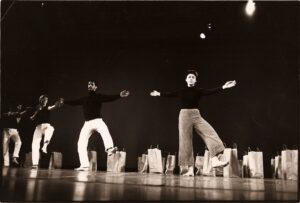
While we look forward to a new future for Movement Research within our permanent home, we are taking a dive into our history and remembering each space we’ve danced, gathered, worked, and held space in since our collective founding in 1978! Each week, we will look back at a different era of the organization. This week we kick off with MR’s first five years, 1978-1983!
In 1978, The School for Movement Research & Construction was founded with a collective structure. Originating during a time when a number of artist-founded organizations are springing up in the U.S, MR provides its founders with informal environments for dialogue & dancing together, & it evolves into a structure that supports workshops in experimental movement investigations.
Periodic performance presentations began in 1979 and the first benefit performance in April 1979, featuring Trisha Brown, David Gordon, Valda Setterfield & Douglas Dunn, at 40 Irving Place was called “the concert of the decade” by press!
1983 marks the first year of Open Performance, a monthly series for artists & students to present works-in-progress to small audiences followed by open discussion of the work by audience & artists, originally held in studios at Ethnic Folk Arts at 179 Varick Street and Simone Forti’s Studio at 537 Broadway.
Throughout these first five years, there is no Movement Research office, with the organization being run out of the backpacks of the Board of Directors across various studios across lower Manhattan where classes & workshops took place, such as KIVA at 307/309 Canal Street, Dance Theater Workshop (DTW) at 219 W 9th Street, and Performance Space 122 at 150 1st Avenue.
To see all locations, check out the Movement Research Map! Be sure to check back each week as we update this map with all of the spaces MR has been from 1978 to now!
2024 – Movement Research Van Lier Artist of Color Fellowship
Movement Research Van Lier Artist of Color Fellowship
2024 Application Guidelines
What is the Van Lier Artist of Color Fellowship program?
A program providing year-long creative research support, rehearsal space, mentorship, performance and related opportunities designed to support the individualized creative process of movement-based artists. Artists must apply as individuals.
The Van Lier Emerging Artist of Color Fellowship program supports the professional development of young artists demonstrating the following:
- An interest in dance-making and the progressive, movement-based arts community;
- Commitment to the field, and to establishing a professional career;
- Between 22 and 30 years of age;
- Identifies as an artist of color from a community underrepresented in the professional New York dance community, such as, but not limited to, Immigrant, Black, Indigenous, Asian/Pacific Islander, Latine/Latinx, Afro-Caribbean and African-American cultures;
- Will not be enrolled in an academic, conservatory, college, or degree-granting program during the Fellowship period.
- This program is funded by organizations that specifically support artists who are residents of New York City. Resident means that your primary residence is in one of the 5 Boroughs of New York City;
- Artists must apply as individuals, and only one individual artist will be granted each residency.
The Fellowship prioritizes multi-marginalized artists such as those experiencing intersectional oppression within race and disability, however all who meet the above criteria are encouraged to apply.
Questions? If you have questions or need help completing this form, please contact Leonor Mendes by email at apply@movementresearch.org or by phone at 212-598-0551.
Application Deadline: Applications must be submitted online by 11:59pm on Tuesday January 16, 2024.
Notification: by Friday, February 2, 2024
Residency Period: from time of notification – December 31, 2024
2024 Movement Research Van Lier Artist of Color Fellowship Application
The Movement Research Van Lier Fellowship supports:
- Rigorous and wide-ranging artistic investigations that are movement-based, but that may incorporate other disciplines and collaborations, with a focus on experimentation.
- Artists who reflect a range of directions and approaches to making work such that there is an interesting confluence of artistic ideas being explored over the course of the Fellowship.
Fellows will receive:
- A Fellowship stipend of $10,000
- A training stipend of $2,000 for class and workshop fees beyond MR offerings*
- A performance ticket stipend & conference/symposium stipend totaling $1000
- A performance fee of $2,500*
- A $1000 performance production budget
- Artistic Mentorship – each Fellow will select an artistic mentor that will provide artistic development feedback throughout the year-long fellowship period
- Professional Consultation – each Fellow will receive $600 for consultations with professionals in the field, as well as ongoing guidance from MR staff on career development, funding opportunities and management skills
- 100 hours of free rehearsal space in MR studios
- Professional dance training with seminal teachers in the field through MR daily classes, MELT workshop intensives, and periodic workshops throughout the fellowship period;*
- Opportunities to attend monthly Movement Research Artist of Color Council meetings and cohort meetings on professional development topics
*Timeline for these activities during the year-long Fellowship will be determined with each
individual Fellow.
The Fellow is required to:
- Show work-in-process through one or more of the following series:
- Movement Research at the Judson Church
- Open Performance
- An opportunity collaboratively determined with the Fellows
- Meet with a mentor throughout the Fellowship period
- Participate in regularly scheduled meetings with MR staff.
- Participate in Van Lier Fellows’ meetings.
- Submit interim and final reports detailing fellows’ activities throughout the year
Application Guidelines:
Be prepared to provide the following information when submitting your online application. Please note that at Movement Research, we collect and review submissions via Submittable. The first step of the submission process is to create a Submittable account, or sign into your existing account. When creating an account, you will be asked for your name, your email address, and a password of your choosing.
Individuals for whom access to an internet or wifi enabled device and/or a reliable Internet connection should contact Movement Research at (212) 598-0551 (voice only) for guidance.
For accessibility purposes, the application can be sent as an attachment by email. Acceptable file types: .doc, .docx, .pdf. To receive the full list of application questions, send an email to apply@movementresearch.org. Please note that the deadline for submitting the application as an attachment is the same as the deadline for submitting your application.
- Eligibility Questionnaire
- Contact Information
- Artistic statement and Relevance of Fellowship (up to 400 words) expressing both personal artistic goals and goals for the fellowship period. Please take into account the following considerations when submitting your artistic statement:
-
-
- Include any motivations, intentions, or inspirations that are a critical part of your artistic process as a whole or for the proposed fellowship.
- Describe any concepts, materials, subjects, processes, structures, influences or questions central to your work.
- What in the specific structure of this Fellowship is most relevant to your creative professional development?
- How do you plan to utilize the resources, including the creative research stipend, and rehearsal space provided to Van Lier Fellows in relation to your current artistic practice? Describe how a sustained relationship with a mentor from the Movement Research community might affect your creative professional development? How do you imagine you’ll utilize access to professional consultation?
-
- CV/Curriculum Vitae
- 1 Work Sample (REQUIRED) that represents your artistic process.
- Please provide a link to a URL of your online work sample – YouTube, Vimeo or other. Vimeo is preferred.
- Sample may be footage from a performance, rehearsal, or in-process showing. When possible, choose a sample that unfolds in “real time”, as opposed to multiple clips edited together. Please do not submit “promo videos,” “teasers,” or “choreography reels”.
- Work sample description (150 words or less). Please explain the relationship between the work sample and your artistic statement. If there is no direct relationship, please tell us why you chose this specific work sample. Please provide a list of collaborators.
- 2nd Work Sample (OPTIONAL) that will offer the panelists additional context around your body of work or artistic process. This work sample is OPTIONAL and will only be viewed if your application is considered in the final round of the panel process.
- Please provide a link to a URL of your online work sample – YouTube, Vimeo or other. Vimeo is preferred.
- Sample may be footage from a performance, rehearsal, or in-process showing. When possible, choose a sample that unfolds in “real time”, as opposed to multiple clips edited together. Please do not submit “promo videos,” “teasers,” or “choreography reels”.
- Work sample description (150 words or less). Please explain the relationship between the work sample and your artistic statement. If there is no direct relationship, please tell us why you chose this specific work sample. Please provide a list of collaborators.
- Demographic Information
-
- Movement Research collects demographic information for internal use only. This information is used to evaluate the reach and access of our programs, and in reporting to our funders. Please note: This information will NOT be made available to the panel and will NOT be used during the selection process.
The Van Lier Fellowship is supported by the New York Community Trust through
the Edward and Sally Van Lier Fund.

j.bouey past Van Lier Awardee