Masculinity and Embodied Practice

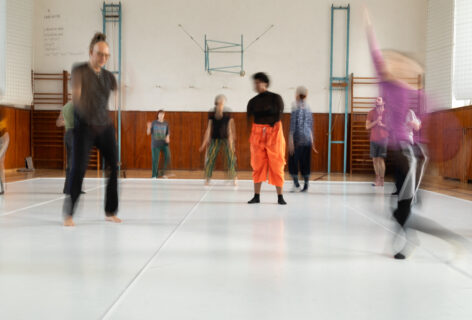
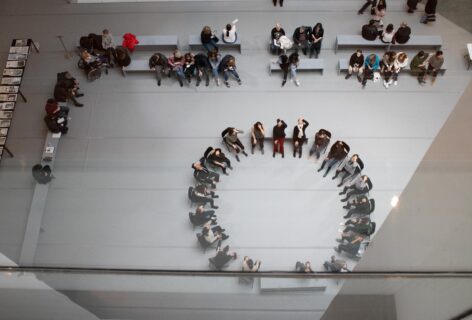
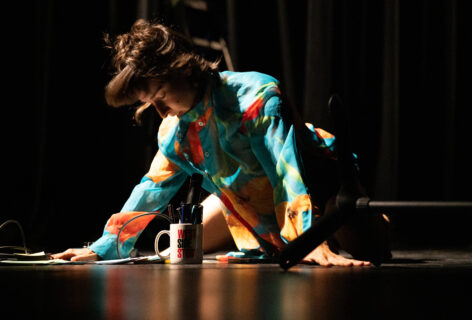
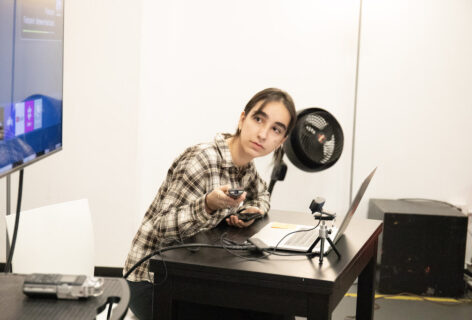
Video with interview and clips from the symposium.

http://vimeo.com/14096802

Thanks to Ivo for making this video!

Ben Spatz
Artistic Director
Urban Research Theater
MR-AIR 2010-2012

The Week Ahead. August 16-22, 2010

Movement Research Gala 2010 Performance, by Alex Escalante

Movement Research Gala 2010 Performance, by Alex Escalante

The Movement Research office will also be closed  August 16-29.

Classes, Workshops, Programs and Events!!!
The Fall schedule begins September 7th! Check out our classes, workshops, Judson Church and Open Performance Schedule, Studies Projects and More!

Check out our website for the full class schedule! http://www.movementresearch.org/classesworkshops/

Our first workshop of the seasons is with Eva Karczag September 13,15, 17! Register online at www.movementresearch.org/classesworkshops/classdescriptions/?class=workshops

The Week Ahead. August 9-15, 2010

Movement Research Gala 2010, by Alex Escalante

Movement Research Gala 2010, by Alex Escalante

This Week at Movement Research… Studies Project, classes, schedule changes, performances, and more!

Thank you all so much for your interest in MELT! We were so excited that all the workshops sold out, and we thank you for braving the heat to come and move with us.

Please note that the Movement Research office is closed on Fridays during the summer, and will also be closed to the public for two weeks, August 16-29, 2010.

Classes this Week.
Join us this week for drop-in classes with Barbara Mahler.

Artist-in-Residence Event.
8 pm. Thursday - Saturday. July 15 - August 14.
Play/War, presented by Urban Research Theater (A.I.R. Ben Spatz)
Two men. Brothers. Strangers.
An explosive journey through intimacy, violence, and liberation.
Medicine Show Theater, 549 West 52nd Street, Third Floor, New York City
www.urbanresearchtheater.com

Polemic: “vocabulary”

The idea that performance work is based on a “vocabulary” of movements or gestures may be useful in some contexts but is also problematic and fundamentally misleading.

Technique is not language. Technique shares some similarities with language, but using language as a metaphor for embodied technique (as many people do) leaves out a huge aspect of technique and collapses the essential differences between performance and writing.

I am not blind to the advantages of the language metaphor and I think I can see why so many theorists (and even artists) have described their work with living bodies in terms of vocabulary, signs, and text. But like any metaphor, this only goes so far.

Language is a specific area of embodied practice. The essential power of language is that it is physically easy to produce very complex differentiations in symbolic meaning. In other words, a very small difference in embodiment produces a very large difference in signification. This is the defining feature of language and what makes it so powerful.

Embodied technique can be said to “signify” in a related way, but there is a huge and crucial difference in that the actual physical production of the signs varies tremendously on a material level.

Illustration: It is not more physically difficult to say the words “ten feet” than to say the words “ten miles.” It is simply a question of moving the lips and tongue in a slightly different way. Anyone who can say “ten feet” can also say “ten miles.” This is why those phrases can be called “signs” or “words” in a “vocabulary.” Precisely because they are easy to produce.

The difference between running ten feet and running ten miles is of a completely different order. Not everyone who can run ten feet can run ten miles. Furthermore, a dance in which a performer runs ten feet is completely different from one in which a performer runs ten miles, not just at the level of “signs” or “text” but also at the level of material reality, the body of the performer, the training and stamina required, the experience of the action, and the physiological results.

This is an elementary example. But the performing arts is fundamentally based on hundreds of details of embodied practice that are much more physically demanding, and physically demanding in different ways, than the articulation or writing down of words. The metaphor of language reveals a certain aspect of embodied practice, its symbolic aspect, but it is absolutely unable to account for all those aspects that have to do precisely with the materiality of embodiment.

Language may be a type of embodied technique, but embodied techniques do not fall within the purview of language.

Ben Spatz
Artistic Director
Urban Research Theater
MR-AIR 2010-2012

The Week Ahead. August 2-8, 2010

Yanira Castro, Photo by Ian Douglas

Yanira Castro, Photo by Ian Douglas

This Week at Movement Research… Studies Project, classes, schedule changes, performances, and more!

MELT IS SOLD OUT!
We are so excited, and we thank you all so much for your interest in our summer workshop intensives! Let’s have a great last week together!

WEEK 5 begins at 10 a.m. Monday, August 2, 2010 at Danspace Project (Saint Mark’s Church at the corner of East 10th Street and 2nd Avenue).
www.movementresearch.org/classesworkshops/melt/

Classes this Week.
Please note that the MELT classes that are listed on the class calendar are NOT drop in classes. You must be registered and have paid full tuition to take part in those workshops.

Join us this week for drop-in classes with Barbara Mahler.

Artist-in-Residence Event.
8 pm. Thursday - Saturday. July 15 - August 14.
Play/War, presented by Urban Research Theater (A.I.R. Ben Spatz)
Two men. Brothers. Strangers.
An explosive journey through intimacy, violence, and liberation.
Medicine Show Theater, 549 West 52nd Street, Third Floor, New York City
www.urbanresearchtheater.com

masculinity as a lineage of technique

Tomorrow is the symposium on Masculinity and Embodied Practice. Apart from a problem with the digital projector, everything is going smoothly, and I am looking forward to an extremely interesting set of paper, presentations, and performances.

In my academic work, I am trying to re-theorize “technique” as something much deeper and more complicated than is usually assumed. Given how fundamental technique is in the performing arts, it is surprising how little it has been theorized. As far as I know, Foucault is the only major theorist to have written extensively on bodily techniques, and that from a perspective of domination and social networks of power rather than on the craft developed by practitioners of embodied forms.

A word, then, about masculinity as technique.

Let us compare masculinity with ballet. There are many iconic images of ballet, but ballet is not fundamentally an image. Nor is it fundamentally a language, even though some aspects of ballet seem to work like semiotics. Once upon a time, in Euro culture, ballet was dance and dance was ballet. Ballet, then, is the name for what people used to do when they danced. It also names a complex legacy of teachers and students, performers and choreographers, painters and royalty.

What if masculinity is not a single role or image, not a biological category, and not a universal signifier… but rather, like ballet, a powerful historical and formerly hegemonic lineage of embodied technique?

Ben Spatz
Artistic Director
Urban Research Theater
MR-AIR 2010-2012

intensity & transparency

intensity
that the body on stage is a different body. that rhythm on stage is a different rhythm. basic principle of performance: that it must be of interest, it must entertain. always something more, something different. not real life. not the mundane. not boring.

transparency
that the body on stage is the performer’s body. that rhythm on stage is the rhythm of that individual in that moment. the performance is life. it may be of interest, it may entertain, it may be mundane, it may be boring. honesty. truth. performance as an embodied practice. done simply in order to do.

This is a question we are working on now in Play/War. Is there a baseline of energetic intensity or hyper-presence below which the performer onstage must not fall? Or are there moments within a virtuosic performance structure when the actual mundane body of the performer can be allowed to appear?

In the past few days we have been exploring a kind of middle zone: Avoiding both the hyper-contrast of “show mode” (almost cinematic in its cuts and edits and discontinuities) and the hypo-kinetics of “plain old Ben and Max” (not cinema, not even theater, just a kind of blink, stop, and we-are-just-a-group-of-people-in-a-room, and then, simply, “the artists are present“).

In this middle zone, a new level of genuine contact suddenly seems possible between the two of us in the act of performing. I wonder if, as time goes by, this contact may extend further into the extremes of intensity and transparency, risking boredom and overstimulation, but perhaps making possible an even more full event to be seen…

Ben Spatz
Artistic Director
Urban Research Theater
MR-AIR 2010-2012

The Week Ahead. July 26-August 1, 2010

Vanessa Anspaugh, Photo by Ian Douglas

Vanessa Anspaugh, Photo by Ian Douglas

This Week at Movement Research…Studies Project, classes, schedule changes, performances, and more!

Thursday, July 29. Studies Project.
10 am. Medicine Show Theater, 549 West 52nd St., 3rd Floor.
Symposium on Masculinity and Embodied Practice
Hosted by Urban Research Theater*, in association with the Movement Research Studies Project Series.
*Ben Spatz, Movement Research Artist-In-Residence 2010 Read the rest of this entry »

Teaching as a Primary Practice

Imagine if teaching were a central value, a touchstone of our culture. Imagine if pedagogy were considered a core practice, perhaps even the most central practice, and the achievements of art and science were understood as secondary to the transmission of knowledge, including embodied knowledge.

Focusing on teaching as a primary practice puts the emphasis on the long term. It also tends to deemphasize what individuals may be capable of through talent or luck, and points instead to what remains possible over time (from generation to generation) because of the care invested in hundreds or thousands of unique teacher-student relationships.

That teaching is not currently valued in this way  is everywhere apparent, not only in the continual encroachment of standardized tests on primary education but also in the lack of financial support for projects of teaching and transmission. Grants for performance have been steadily shrinking over the past decades — but grants for high-level pedagogical projects are a figment of my personal imagination.

One manifestation of pedagogical questions is the gap between hard-core technical training and the more recent (historically speaking) notion of critical thinking and education as a crucial part of democracy. For me this is just about the most fascinating question in the performing arts today. There is such a clear schism between, on the one hand, the seemingly archaic “training” practices of conservatory schools, a few performance ensembles, traditional song and dance lineages, and the military; and on the other, the new “contemporary” generations of visual and performing arts, which have so strongly rejected technique, discipline, and craft in favor of direct engagement with the socio-cultural moment.

Two approaches to education and to the place of pedagogy in society? A search for or negotiation of the balance between pedagogy as training / kn0wledge transmission and pedagogy as a practice of freedom, empowerment, and mutual discovery? What do teachers know? What do students learn? I have had this conversation so many times, in so many different contexts. Still it seems muffled, underground, unnoticed. Whereas I believe it is a central question for our times.

Urban Research Theater has organized a four-day intensive workshop in theatre/performance (August 2-5) with guest teachers Kameron Steele (The South Wing); Brooke O’Harra (Theatre of a Two-Headed Calf); Gian Murray Gianino (SITI Company); and Daniel Irizarry (Columbia University); as well as Maximilian and myself. Each teacher will offer one or two introductory training sessions, and in the evening will discuss or present excerpts from their work.

I would like to think that this kind of workshop represents a step towards the moment in which theater (in the U.S.) will catch up to dance (in the U.S.) in its tackling of questions of pedagogy and transmission. It would be great to have some MR folk there.

Ben Spatz
Artistic Director
Urban Research Theater
MR-AIR 2010-2012

The Week Ahead. July 19-25, 2010

HeJin Jang, photo by Ian Douglas

HeJin Jang, photo by Ian Douglas

This Week at Movement Research…Studies Project, classes, schedule changes, performances, and more!

WEEK 3 OF SUMMER MELT!
Movement Research’s summer MELT intensive WEEK 3 begins Monday, July 19, 2010. Many of the workshops for this summer’s intensive have sold out, however there are still workshops that have open spots. Register now for amazing workshops with Yvonne Meier and Ishmael Houston-Jones!
www.movementresearch.org/classesworkshops/melt/

Classes this Week.
Please note that the MELT classes that are listed on the class calendar are NOT drop in classes. You must be registered and have paid full tuition to take part in those workshops.

Join us this week for drop-in classes with Barbara Mahler and Charlie Mosey.

Artist-in-Residence Event.
8 pm. Thursday - Saturday. July 15 - August 14.
Play/War, presented by Urban Research Theater (A.I.R. Ben Spatz)
Two men. Brothers. Strangers.
An explosive journey through intimacy, violence, and liberation.
MEDICINE SHOW Theater
549 West 52nd Street, Third Floor, New York City

Upcoming.
July 29, 2010
Symposium on MASCULINITY AND EMBODIED PRACTICE
Hosted by Urban Research Theater in partnership with the Movement Research Studies Project Series
Medicine Show Theater, 10:00 am

upcoming classes & workshops

  • Levi Gonzalez
    September 7
    Tuesday 10:00 am-12:00 pm
    Morning Class
  • Barbara Mahler
    September 7
    Tuesday 6:15 pm-7:45 pm
    A Re-Education - Klein Technique
  • Barbara Mahler
    September 7
    Tuesday 10:00 am-12:00 pm
    A Re-Education - Klein Technique
see all classes & workshops ›

join our mailing list

upcoming performances & events

see our performances & events ›

movement research feeds